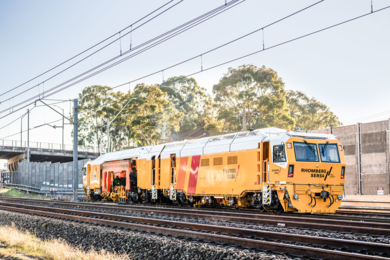
Modernising track construction machines increases availability, quality,safety and service life.
Whether as part of a planned modernisation or following a damage event, the RSRG offers major overhauls that renew machines sustainably and adapt them to current requirements. Two practical projects illustrate this approach.
High-speed ballast profiling machine (SSP)
In Spremberg, a high-speed ballast profiling machine (SSP) underwent a comprehensive major overhaul to safeguard its performance over the long term. The focus was on modernisation, reliability and high technical availability – decisive factors in the day-to-day construction-site work of the RSRG’s customers.
As part of the work, all operating units, including ploughs, brush box, silo, brush holders and loading equipment, were completely reconditioned. The cab was fully renewed, including new interior panelling, control desks and windows, significantly improving ergonomics and safety for the operating personnel.


A key element was the complete rewiring of the vehicle. The control system was also replaced to enable more precise processes and reduce susceptibility to faults. At the same time, all hydraulic components were renewed and the hose and pipework replaced. Finally, the vehicle received a new paint finish in the modern Rhomberg Sersa design.
The overhaul took around 10 months. One particular challenge was the close coordination with specialist bodies in order to implement all modernisations without triggering a change to the vehicle’s approval. Thanks to this careful clarification, the SSP has been technically up to date and fully operational since summer 2026.
MTW 10 motorised tower wagon
The repair of an MTW 10 motorised tower wagon at the Wels workshop began from a very different starting point – the vehicle had been severely damaged by fire. However, a comprehensive overhaul and restoration returned the MTW 10 to operational condition.
The machine was completely dismantled, sandblasted, painted and then rebuilt. A large proportion of the components were renewed or reconditioned to as-new condition. The vehicle was also adapted to current standards, particularly in the area of fire protection. All pipework was renewed, and the loading crane mounted on the MTW underwent a complete overhaul. A dedicated assembly fixture was manufactured specifically for this work.


The electrical system was also completely renewed. A particular challenge was that some cables and wiring could no longer be traced because of the fire damage. They had to be painstakingly reconstructed using the available documentation and comparisons with machines of the same design. In addition, some spare parts for the 2000 model year were no longer available and had to be custom-manufactured.
Thanks to extensive specialist expertise and precise implementation, the project was completed successfully within 11 months. The MTW 10 has been back in service since the beginning of March 2026.
Both projects demonstrate that major overhauls are an economical and sustainable solution – both for modernisation and for restoration following damage events. Compared with purchasing a new machine, customers also benefit from lower investment costs, shorter delivery times and reduced training requirements.